
81% of programs still require a human to approve every ad. Ours don’t. When every ad is built and purchased through Co-Op Command, a dealer can’t produce one that breaks the rules.
Co-Op Command is the difference. It is the system we built to run co-op: one ledger for the funds, one checkout for every medium a dealer can buy, the brand’s rules enforced before a dollar moves, and every document and proof captured automatically. The other administrators run on approval queues, envelopes, and checks. We run on software written for exactly this, which is why our programs need none of that.
We run co-op, MDF, and local marketing programs end to end: funds, claims, dealer support, compliance, reporting. Your team funds the program and reads the reports. Everything in between is ours.
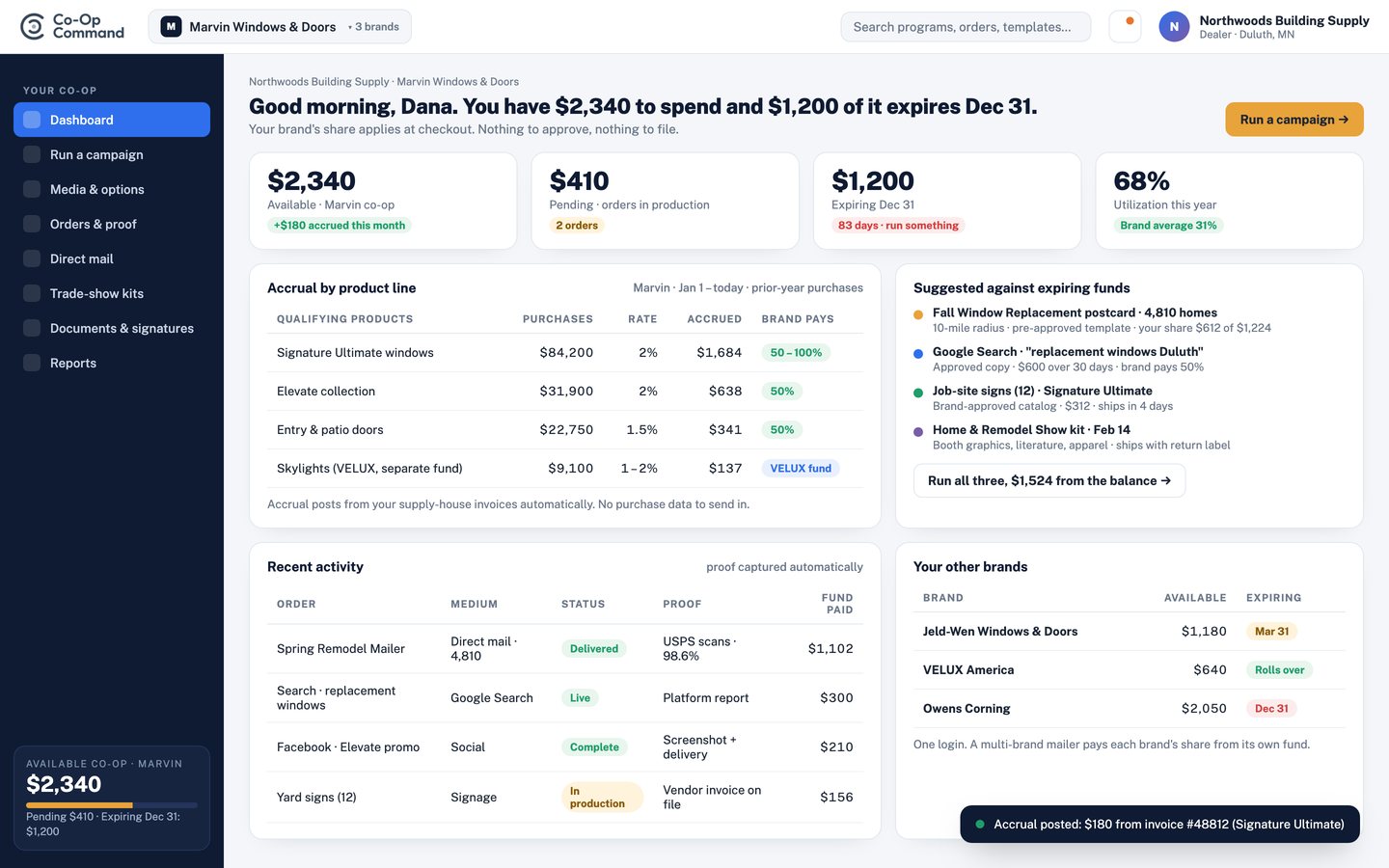
Every program, every dollar, and every purchase history. One dashboard.
Auto-approved templates. Dealers drag and drop assets that were approved the moment you uploaded them.
We compared every manufacturer plan published in 2018 with every plan listed today. Four in five are gone. Of the survivors, 305 slid from an active accrual program to “partial” or “no co-op.” Rates barely moved. Programs did not get cheaper. They got cancelled.
A co-op program costs money to administer and only pays off when dealers use it. Prior approvals, claim packages, and check runs make it expensive on the brand side and tedious on the dealer side. Usage falls, the line item looks like waste, and the program is cut or left to lapse.
On today’s plans, media that requires prior approval outnumbers pre-approved media two to one, in every channel. On Co-Op Command approval happens once, when the template is configured. The queue never forms, so dealers actually run the ads, so the program earns its keep.
85% of active plans name social, search, email, streaming, or OTT specifically. The paperwork model was built for newspaper. Pre-loaded creative and locked zones work exactly the same for a Facebook ad, a Google search ad, a radio script, or a banner plane over the beach, and the proof is captured by the buy. See every medium we fund →
Cheaper than the administrator you have. Better than shutting the program down, which is what most brands did. Get a Program Review →

Co-op programs are a pile of requirements: what the ad must look like, how the dealer proves it ran, who qualifies for the money. We catalogued all of them, asked why each exists, and compared how a traditional administrator handles it with how it works when the program runs on Co-Op Command. Re-checked against the plans listed in 2026: prior approval is still required on 81% of plans that list media (759 of 932), approval-required media lines outnumber pre-approved two to one, 267 plans require a signed authorization form, 267 keep the accrual ledger with a third party, and every one of those rules is a configuration setting in our system.
What the ad must look like, and who checks. Showing the 6 most common of 16.
| Requirement | Why it exists | How the other guys handle it | How Co-Op Managers handles it |
|---|---|---|---|
| Logo required, prominent, current, correct colors83% of plans | Brand presence must be visible for the manufacturer to pay for the ad. | A reviewer eyeballs each dealer-built ad against the brand guide. Wrong logo version or size means a revision cycle. | Logo is a locked template zone. Current version and color rules are enforced by the asset library. |
| Prior approval of the ad before it runs81% of plans | Dealers build their own ads, so a human at the manufacturer has to check each one. | Dealer emails or uploads the ad; an approver reviews it in 24 to 48 hours; revisions restart the clock. 81% of plans require it. | Locations can only run templates from the approved library with locked brand zones. Nothing non-compliant can be produced, so there is nothing to approve. Approval routing still exists for spend above a threshold, not for creative. |
| Manufacturer ad materials preferred or required69% of plans | Protects brand consistency; reduces review work. | Ad slicks and files are mailed or posted to a download page. Dealers hand them to a local designer and hope the result passes review. | Template library with locked / semi-locked / open tiers per asset. |
| Product illustration or photo required66% of plans | Ad must actually feature the product being subsidized. | Reviewer checks the ad shows the product. Missing or outdated imagery is a common rejection reason. | Template zones pull from the brand photo library; a product-image zone can be made mandatory. |
| Brand or trademark name prominent in headline or copy57% of plans | Co-op is paid for brand exposure, not generic store ads. | Reviewer judges “prominent.” Disputes are settled by email. | Locked copy zones and headline templates; registry marks baked into assets. |
| Prorate multi-product or shared ads by space49% of plans | When a dealer ad shows several brands, each pays only for its share. | Someone measures each brand’s share of the page with a ruler and prorates the claim. Each brand approves its slice separately. | The manufacturer supplies either pre-loaded creative or a template with defined zones for multiple products or brands. The zones are locked in the template, so each brand's share of the ad is fixed by design and the split is known before the ad is built. No after-the-fact prorating. |
Proving the ad ran and getting paid. Showing the 6 most common of 16.
| Requirement | Why it exists | How the other guys handle it | How Co-Op Managers handles it |
|---|---|---|---|
| Paid media invoice91% of plans | Manufacturer cannot see the buy; the invoice proves cost and date. | Dealer collects the paid invoice from the newspaper, station, or vendor and mails or uploads it. 91% of plans require it. | The platform places the buy, so the invoice is generated internally and attached automatically. |
| Full-page tearsheet or copy of the ad as run90% of plans | Proves the ad actually appeared, with publication name and date. | Dealer tears the page out of the newspaper, or requests an e-tear, and sends it in. 89% of plans require it. | Tearsheets and e-tears are captured by the media-buying flow and attached to the transaction automatically. |
| Claim deadline after the ad runs (typically 30 to 90 days)85% of plans | Paper claims arrive late; deadlines protect the manufacturer's books. | Miss the window and the reimbursement is gone. Most common deadline: 60 days. | Claim completes when the ad runs. Claim windows remain a configurable eligibility check. |
| Original documents only; photocopies or proofs rejected46% of plans | Same fraud control. | Originals mailed in envelopes because copies could be altered. | Not needed. Obsolete under a system-of-record model. Digital originals are the record. |
| Manufacturer's own claim form41% of plans | Their intake process; standardizes what the processor sees. | A PDF or paper form per brand, filled out by hand, attached to every claim. | Not needed. The claim is a system record, complete the moment the ad runs. |
| Postal receipt, USPS Form 3602, or distribution affidavit36% of plans | Proves the mail piece or insert was actually delivered. | Dealer collects the postal receipt from the mail house and a signed affidavit of distribution. | Direct mail and EDDM fulfillment produce the postal documentation as a byproduct. |
Who qualifies, how funds accrue, what they cover. Showing the 6 most common of 28.
| Requirement | Why it exists | How the other guys handle it | How Co-Op Managers handles it |
|---|---|---|---|
| Eligible media list (which channels qualify)94% of plans | Manufacturer decides which channels earn reimbursement. | Listed in the program PDF. Dealers guess, or ask the rep. | Approved media mix per program; eligibility check verifies media type. |
| Participation split (manufacturer pays X% of the ad)86% of plans | Shares cost so the dealer has skin in the game. | Dealer pays the vendor in full, files the claim, and waits weeks for the brand’s share to come back as a check or credit. | Any ratio by tier, program, or campaign, applied at checkout. |
| Terms undocumented; "contact manufacturer or sales rep"79% of plans | The program lives in a rep's head, not a system. | The program lives in the rep’s head. 79% of plans say “contact manufacturer for details.” | Program parameters are configured once and visible to every location. This is the core pitch. |
| Authorized, qualifying, or stocking dealer status71% of plans | Only the manufacturer knows who is a legitimate dealer. | Claims processor checks the dealer against a roster, often a spreadsheet. | Location roster and tiers are set by corporate; eligibility is checked before any spend. |
| Specific product lines or brands only57% of plans | Manufacturer funds some lines and not others. | Reviewer checks the ad shows eligible lines; processor checks the claim. | Per-program product scope. |
| Accrual as a percent of dealer purchases51% of plans | Ties ad money to what the dealer actually buys. | Someone pulls purchase reports and calculates each dealer’s fund in a spreadsheet, monthly or annually. | Accrual is computed from the brand's purchase data as it posts, per location. The balance a dealer sees is current, not last month's spreadsheet. |
We administer the program end to end: rules, funds, claims, dealer support, compliance, and reporting. Your team funds it and reads the reports. Because it runs on Co-Op Command, there is no approval queue, no chasing proof in any medium, and no month-end reconciliation.
How we manage co-op → Run it yourself
The platform we built to run programs without the manual work. One ledger for funds, media buying, print and promo ordering, and reporting. Available to brands with an in-house co-op team who want to run it themselves.
See the platform →Every program we manage runs on these three pieces. Most administrators are strong at one of them and outsource the rest. We built all three into one system, which is why our service does not need a queue of people approving things.
Accrual formulas, tiers, caps, and eligibility windows apply automatically to every location, every cycle — with claims and approval routing built in.
Explore Fund Management →The same system that governs the fund is where local operators actually spend it: search, social, streaming, TV, radio, direct mail, out-of-home, print, signage, and promo, every medium a dealer can buy, from one balance.
Explore Media & Ordering →Every dollar spent flows into reporting corporate can use — compliance, attribution, and program depth, without chasing proof by hand, in any medium.
Explore Brand Control →The same flow runs whether a location is launching a Google campaign, ordering signage, or submitting a direct-mail claim for reimbursement.
Corporate sets the rules once. Balances update on their own as activity qualifies.
Buy media, order goods, or submit a claim against the live available balance.
Requests route through the sign-off chain that matches your structure.
Utilization, ROI, and compliance roll up automatically.
The same geographic infrastructure that powers direct mail targeting also supports territory mapping and site-selection tools elsewhere in Co-Op Command.
* We do zip codes too. We just don’t stop there.
Most platforms in this category do one half of the job well — either they administer and audit the fund, or they help you spend it. Very few do both under one login, against one source of truth. That split is where reconciliation breaks: a claim gets approved in one system, the purchase happens somewhere else, and matching the two becomes someone's manual job every month.
One balance, one ledger — nothing to export and match by hand
Approval and purchase live in the same flow — nothing spends without sign-off
Reporting reflects what actually happened, not what was requested weeks ago
Co-Op Command replaces the patchwork most programs run on today — a fund spreadsheet, a separate ad-buying tool, a print vendor portal, and an inbox for approvals. Everything below runs through the same ledger.
Franchise systems, dealer networks, and multi-location brands run into the same problem: money is committed centrally but spent locally, and someone has to keep it honest.
National advertising fund and local co-op dollars, from launch kits through ongoing local store marketing.
Manufacturer-funded co-op and MDF programs across independently owned locations, with consistent brand rules.
Corporate-funded local marketing budgets that need real spend enablement, not just a request-and-wait portal.
Teams managing dozens or hundreds of local markets who need one system instead of one tool per channel.
Every program is different — the tiers, the fund rules, the org chart. A real walkthrough with your own numbers is the fastest way to see the fit.

We'll show you how allocation, claims, media buying, and physical ordering work together in a single system, using a program that looks like yours.